When man comes to the point when he realizes that belief in God is impossible without Him, when he sees himself to be so small in the eyes of God that he must cry out for help, when he is enlightened to the fact that he is nothing, then God gives the grace to believe. Here man is a willing recipient because he knows that, what little faith he receives, it is from God. Because the grace to believe is given to man in such a lowly state, the second one begins to deviate from this state, the battle for faith begins. Once man starts to give reason for faith or justify it in a way that he can comprehend it, living faith begins to die. If man should start to tell himself that his faith is strong, the opposite is true and his faith is dying-for it is faith based on human rationality and not God-given. It is this battle between living faith and dead faith that a true Christian must always battle and it is this battle that causes a true Christian to have such a weak, wavering faith. God does want a man to justify his belief for in doing so man takes away from God the grace He has bestowed upon us. This justification of faith leads to self-righteousness. Self-righteousness battles God for the hearts of men. Self-righteousness steals from God what is rightfully His and gives credit to man, who is an all-to-willing recipient. Faith based on self-righteousness is strong and unwavering for it rings true in the minds of men and man comprehends it. -- OALCer
So if I recognize my relative "nothingness" in relation to the majesty and glory of God and I feel him respond to me (I "believe"), do I have "living faith?" Am I as "saved" as an OALCer? Am I as welcome in heaven as you are? Do you think you (or any OALCer, preacher or other) KNOW if I or any of us truly has "living faith" or "dead faith?" I KNOW you don't know and I also KNOW (from personal observation in the OALC) that your OALC preachers speak as if they at least do. Rubbish. Arrogance. Self-righteousness, masquerading as humility. -- MTH
Monday, February 05, 2007
Faith, Alive or Dead
Time for a new thread, so you don't have to wade through the torrent of comments (172!) on the OALC topic. Thanks to all of you for keeping the discussion civil (if not always coherent, heh). Here is an excerpt from our OALCer's definition of living faith, followed by a rejoinder from MTH.


Tuesday, January 30, 2007
Come With Us to Pajala
 Okay, I can't afford it either. But that's what credit is for, and life is short, and this is an opportunity that may not come around again. When will you get to visit "the place where it all started" with others who share your heritage and the reknowned Bengt Pohjanen as tour guide? Never. Unless you come with us this summer. So far, three of us are intending to make the trip. Please consider joining us.
Saturday, January 27, 2007
Laestadianism and Sami Culture
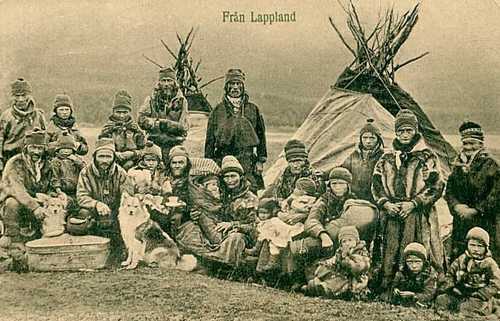
I recently had an email exchange with Nathan Muus of BÁIKI, The International Sámi Journal, and he gave me permission to post the following:
Yes my friend grew up in, and still is involved in the Firstborn . . . some of my ancestors participated in "like minded" religious movements in the 19th century in Norway. Home meetings, lay pastors, singing hymns with a one string instrument, suspicion of the Swedish/Norwegian state church and not wanting to pledge allegience to the king- the Laestedian movement was one of a number of such movements, not alone. People forget that.
However, the Laestedian movement was Sami led, and there are a number of "positives" to the movement at the time. Some of them are reflected in the Kautokeino revolt, which was Laestedian led also. Sami men were going to the city markets with a year worth of hides, crafts, goods to sell/trade. They were returning back to camp with nothing, no money, drunk..so is said. They were sold alcohol and cheated, taken advantage of. Sami languages were considered worthless, so was Finnish somewhat, by the way. The state church service was in Swedish, or Norwegian, with Latin flourishes. Laestedius deemed that Sami and Finnish were worthy languages to preach in. He deemed that simple was good, hence many people in a village dressing alike in traditional Sami clothing was ok. A simple Sami home or tent, not extravegantly adorned, was normal and was uplifted. I can understand why the movement had such a pull. The Sami traditional spiritual world had been battered for some centuries. This movement gave people an outlet.
I continue to be saddened that denial of Sami cultural heritage/identity today is still there. And I do know it is there. Yet some of the same people will often in their own ways, keep their Sami spirit and identity. I do not for a minute believe academically or otherwise, that traditional Sami spiritual beliefs and practices all were wiped out and went away. Evidence points otherwise to that. However, perhaps some people cannot reconcile the two religious worldviews well, hence continuing denial.
Popular misconceptions do not help either, ie."witches drum"; since when were those using a Sami drum a European style witch? The colonizers had many things wrong. Unfortunately some/a lot of that got transmitted into the various Lutheran church movements also. It's up to all of us to help sort it out. Blessings on your journey! Nathan
You may want to read this fascinating exploration of the impact of Laestadianism on Sami culture. (Among other things, it includes details about "Lapp Mary" that are new to me.)
Does Laestadianism keep Sami culture alive in some way? If so, how?
Friday, January 26, 2007
Laestadius, the Musical (I kid you not)
Wait no longer, music-loving Laestadians (current and former alike). There is now a musical, or "uupera"about our man Lars Levi. It is written by Bengt Pohjanen, who has extended a personal invitation to extoot readers:
Ok, I'm going! "Stranger in a Strange Land" will be there, too. We'll probably aim for a show the last weekend of June.
Give it some thought . . . and if you'll be my translator, I'll buy your theatre ticket.
"I have just written a libretto for a musical or folkopera about Laestadius. It will be performed on that place i Kengis (south of Pajala) where Laestadius worked. The famous composer, Kaj Chydenius i Helsinki, will compose the music. So I think that this event could be of interest for many in Ex-toots."
Ok, I'm going! "Stranger in a Strange Land" will be there, too. We'll probably aim for a show the last weekend of June.
Give it some thought . . . and if you'll be my translator, I'll buy your theatre ticket.
Tuesday, January 23, 2007
What is the OALC?
I've closed comments on the previous thread so we can focus our attention on one topic for awhile. It seemed best to choose a Laestadian-related topic (hang in there, philosophers, your time will come). I implore all of you to be respectful and deal with specifics, not generalities, To start things off, here is a history of the OALC that "LLReader" has been supplying.
(If you have an unanswered question from the previous thread, please post it again.)
From "A Godly Heritage" (written by six theologians, historians, and such, along with two pastors of Apostolic Lutheran Churches):
(If you have an unanswered question from the previous thread, please post it again.)
From "A Godly Heritage" (written by six theologians, historians, and such, along with two pastors of Apostolic Lutheran Churches):
The OALC was founded in 1903 in Calumet and has stayed separate from the other groups since then. There have been no major spits in this group, and the Heidemen, ALC, and all the other splinter groups have nothing to do with the OALC, since they split off in 1903. It's the biggest Apostolic group -- having around 10,000 members.
The OALC book ("History of Living Christianity" written by a committee of OALC members in 1974) says that Andrew Brenner, a Finn from Hammerfest, Norway was the first in the US to preach the true word. He arrived in Calumet around 1867. He sent a ticket to his friend Solomen Korteniemi to come help spread the word -- big trouble followed! In 1872 the first Apostolic congregation was formed, called the Solomon Korteniemi Lutheran Society.
There was so much fighting going on that the Elders sent Henry Parkajoki and Aapo Tapani to Calumet to calm things down. Arguing increased, so in 1877 John Takkinen and Frans Niska from Oulu, Finland were sent. Takkinen was a force to be reckoned with, it was said he ruled with an iron hand, just as Korteniemi was doing. Both had fiery tempers and from what I can understand, much of the dissension in the Apostolic congregation was as much a result of these two personalities as anything else.
Takkinen's side accused Korteniemi of drinking and spreading lies. In 1879 the church name was changed from "Solomon Korteniemi Lutheran Society" to "Finnish Apostolic Lutheran Congregation". Takkinen became part of a publishing company around 1880, and produced an Aapinen in which the words "descended into hell in Gethsemane" were inserted. That made people mad, saying things like, "Who does he think he is? Even Luther hadn't changed any words in the Apostles Creed." (I understand that today the only group that uses the altered creed is the OALC in America. It isn't used in Finland.)
The Elders continued to send other preachers to try to reconcile the Apostolics. Some of the preachers who were sent were Henry Berg, John Mullo, Peter Stolberg, Eliel Juola, and John Rovanpaa. These men were all considered by Takkinen's followers as false teachers. Takkinen was voted out of the Apostolic Lutheran Church on Pine Street. He and his group built a new church in 1892 and called it the "Finnish Laestadian Lutheran Sunday School and Mission Society". John Raattamaa was still the leader of the Apostolics in Scandinavia. He wrote to Takkinen and advised him to change the name to the Old Finnish Apostolic Lutheran Congregation (later tweaked to Old Apostolic Lutheran Church)---and tra-la the OALC was born.)
Under Takkinen's leadership the services were simplified. They quit standing for the Apostles Creed and kneeling during the general confession of sins, which had been done by the congregation in unison. Organs were no longer used, and taking oaths and making the sign of the cross at baptisms was eliminated. An alter railing was added for communion. The ministers didn't wear vestments. The service usually was two hours long, with hymn singing and mostly preaching.
Subscribe to:
Posts (Atom)